
Plump It Up: What Are the Best Peptides for Skin in 2026?
What Are the Best Peptides for Skin?
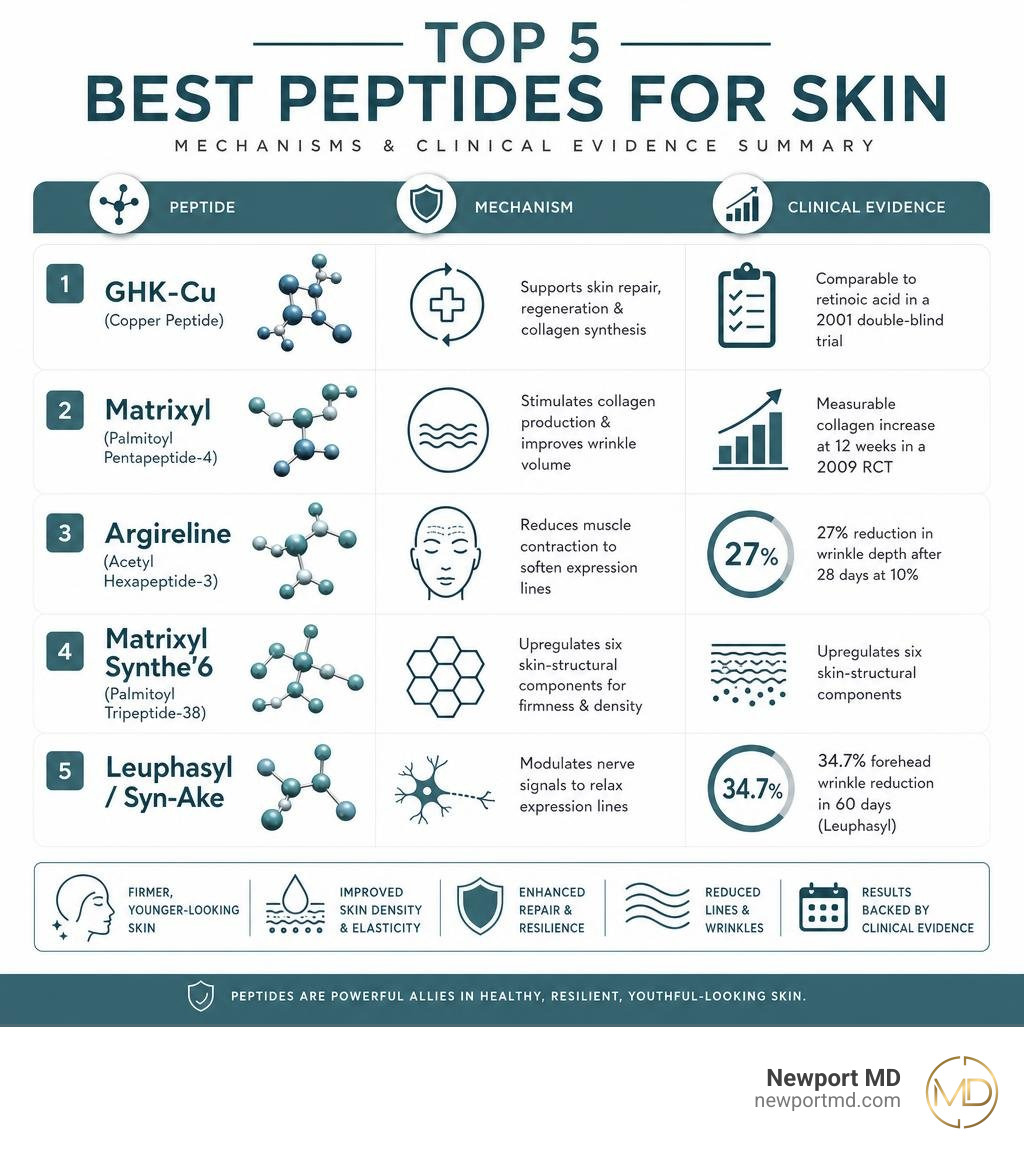
If you want a quick answer on what are the best peptides for skin, here it is:
| Peptide | Best For | Key Evidence |
|---|---|---|
| GHK-Cu (Copper Peptide) | Skin density, cosmetic repair, regeneration | Comparable to retinoic acid in a 2001 double-blind trial |
| Matrixyl (Palmitoyl Pentapeptide-4) | Collagen stimulation, wrinkle volume | Measurable collagen increase at 12 weeks in a 2009 RCT |
| Argireline (Acetyl Hexapeptide-3) | Expression lines, forehead wrinkles | 27% reduction in wrinkle depth after 28 days at 10% |
| Matrixyl Synthe’6 (Palmitoyl Tripeptide-38) | Skin firmness, structural density | Upregulates six skin-structural components |
| Leuphasyl / Syn-Ake | Neuromuscular expression lines | 34.7% forehead wrinkle reduction in 60 days (Leuphasyl) |
Here’s something worth knowing: your skin is losing collagen right now. Starting in your late twenties, collagen declines roughly 1–1.5% every year. By your fifties, that adds up fast — and it shows in skin that looks thinner, looser, and more lined than it used to.
Peptides are short chains of amino acids that may act as cellular messengers — signaling skin cells to do things like produce more collagen, support cosmetic tissue repair, or moderate muscle-driven creasing. They occur naturally in the body, but levels fall with age.
The challenge? The skincare industry and the research world are often talking about completely different things when they say “peptides.” Many commercial products contain concentrations well below what clinical studies actually tested. And not every peptide works the same way or targets the same concern.
This guide cuts through the noise. We’ll look at which peptides have real human trial data behind them, how they compare head-to-head, and how to use them in a cosmetic routine that actually makes sense for your skin — with guidance grounded in science, not just marketing.

To understand what are the best peptides for skin, we first have to understand what they are at a biological level. Peptides are short chains of amino acids (typically between 2 and 20) linked by peptide bonds. When these chains grow longer, they form proteins—such as collagen, elastin, and keratin—which serve as the literal scaffolding of your skin.
Topical collagen molecules are generally too large to penetrate the skin’s outer barrier (the stratum corneum). Peptides, however, are much smaller. When formulated correctly, they can slip into the upper layers of the skin to deliver biological “instructions.”
In advanced cosmetic dermatology, we group these amino acid chains into four primary functional categories, as highlighted in the Top 5 Best Skincare Peptides for 2026 | Peptide Mind:
- Signal Peptides: These act as molecular messengers. They mimic the natural breakdown fragments of collagen, tricking your skin into believing it has suffered a minor injury. In response, your fibroblasts (the cells responsible for structural proteins) ramp up the production of fresh collagen and elastin.
- Carrier Peptides: These deliver critical trace minerals—like copper—directly to the cells. Copper is a vital cofactor in enzymatic reactions that govern cosmetic tissue repair and antioxidant defense.
- Neurotransmitter Inhibitors: Often referred to in marketing as “topical Botox,” these peptides work at the neuromuscular junction. They subtly interfere with the proteins required for muscle contraction, helping to soften the appearance of expression lines.
- Enzyme Inhibitors: These work by turning down the activity of enzymes (like matrix metalloproteinases, or MMPs) that naturally degrade collagen and elastin as we age or experience UV exposure.
Clinical Evidence: What Are the Best Peptides for Skin According to Science?
The beauty industry is notorious for riding on the coattails of single-cell laboratory studies. However, a few select peptides have accumulated robust, peer-reviewed human clinical trial data. When evaluating what are the best peptides for skin, we look for clinical evidence of improved skin density, reduced wrinkle depth, and enhanced barrier function.
As noted in What Are the Most Effective Peptides for Skin? – Vogue, dermatologists frequently emphasize that while peptides are incredibly gentle and well-tolerated, their real-world outcomes depend heavily on the specific peptide sequence and its concentration.
The clinical highlights for the top three researched peptides show compelling results:
- GHK-Cu (Copper Tripeptide-1): Discovered in 1973 by Dr. Loren Pickart, this carrier peptide has over 40 years of research backing its regenerative properties. A key 2001 double-blind, placebo-controlled clinical trial of topical GHK-Cu demonstrated significant improvements in skin thickness and wrinkle depth that were comparable to retinoic acid (retinol’s prescription-strength sibling)—but notably without the redness, peeling, or irritation typical of retinoids.
- Matrixyl (Palmitoyl Pentapeptide-4): This signal peptide has some of the strongest cosmetic-grade human evidence available. A 2009 randomized, double-blind, placebo-controlled clinical study evaluating a 3% Matrixyl formulation found measurable reductions in overall wrinkle volume. Histological evaluations confirmed a significant increase in collagen density at the 12-week mark.
- Argireline (Acetyl Hexapeptide-8 / Acetyl Hexapeptide-3): This neurotransmitter inhibitor targets dynamic expression lines. In a landmark 2002 trial, a 10% Argireline emulsion applied twice daily reduced periorbital wrinkle depth by up to 27% after 28 days. This finding was confirmed again in 2021 research using the same clinical concentration, demonstrating its consistent performance for smoothing forehead and eye-area lines.
How to Choose What Are the Best Peptides for Skin for Your Routine
Selecting the right peptide is not a one-size-fits-all process. Your choice should align with your primary skin concerns, whether you are looking to restore a compromised skin barrier, smooth out dynamic expression lines, or address the structural thinning associated with hormonal shifts.
For instance, women in their late 40s to 60s face a unique biological transition. During the first five years post-menopause, women typically experience an approximate 30% decline in remaining skin collagen due to dropping estrogen levels. This “collagen cliff” leads to sudden thinning and loss of elasticity. In this scenario, signal and carrier peptides like GHK-Cu and Matrixyl are highly beneficial, as they work independently of estrogen pathways to support fibroblast activity.
If your primary concern is a damaged skin barrier—marked by redness, flaking, or sensitivity to active ingredients—carrier peptides and barrier-supporting signal peptides can help restore equilibrium. They assist in rebuilding the lipid barrier and calming surface appearance.
Conversely, if your focus is preventing or softening dynamic wrinkles (such as crow’s feet or forehead furrows), neurotransmitter-inhibiting peptides like Argireline and Leuphasyl are the logical starting point.
For those looking to optimize their overall wellness and longevity protocols, our Health Optimization Blog regularly explores how topical care and systemic therapies work hand-in-hand to support vitality from the inside out.
GHK-Cu vs. Matrixyl vs. Argireline: Mechanism and Comparison
When designing a targeted skincare routine, it helps to compare the heavy hitters of the peptide world side-by-side. While all three are outstanding options, they operate via entirely different biological pathways.

To help you visualize how these three powerhouses stack up, let us examine their molecular targets, primary benefits, and ideal use cases:
- GHK-Cu (Copper Tripeptide-1):
- Class: Carrier Peptide
- Primary Cellular Mechanism: Activates Wnt/beta-catenin signaling; modulates gene expression; delivers copper ions to copper-dependent enzymes.
- Target Layer: Dermis & Epidermis (comprehensive remodeling)
- Best For: Overall skin density, accelerated wound healing, post-procedure recovery, and calming redness.
- Matrixyl (Palmitoyl Pentapeptide-4):
- Class: Signal Peptide (Matrikine)
- Primary Cellular Mechanism: Mimics collagen precursor fragments to stimulate fibroblasts to synthesize Collagen I, III, and IV, as well as hyaluronic acid.
- Target Layer: Deep Dermis (structural rebuilding)
- Best For: Loss of firmness, structural sagging, and deep-set static wrinkles.
- Argireline (Acetyl Hexapeptide-8):
- Class: Neurotransmitter Inhibitor
- Primary Cellular Mechanism: Competes with the SNAP-25 protein to destabilize the SNARE complex, mildly inhibiting muscle contraction signals.
- Target Layer: Neuromuscular Junction (surface expression lines)
- Best For: Dynamic forehead lines, crow’s feet, and marionette lines.
As detailed in The Best Peptide Serum: Evidence-Ranked Guide | FormBlends, understanding these distinct pathways allows you to build a complementary routine rather than simply stacking multiple products that do the exact same thing.
GHK-Cu: The Copper Carrier Peptide
GHK-Cu is one of the most biologically active compounds you can apply to your skin. This naturally occurring tripeptide (glycyl-L-histidyl-L-lysine) has a high affinity for copper. At a cellular level, GHK-Cu is associated with the modulation of over 4,000 human genes—essentially helping to shift aged or damaged fibroblast gene expression toward a more youthful state.
By delivering copper directly into the cells, GHK-Cu supports tissue remodeling and antioxidant defenses. It helps clear damaged collagen and elastin from scar tissue and replaces it with normal, healthy fibers. This makes it an exceptional choice for improving skin density and reducing redness.
According to the editor testing logs highlighted in the 8 Best Peptide Serums for Plump, Bouncy Skin | Allure, users often report a visible reduction in skin reactivity and a plumper, more resilient texture within just a few weeks of consistent use.
Matrixyl: The Collagen-Signaling Matrikine
Matrixyl operates on a clever biological trick. When collagen naturally breaks down over time, it leaves behind small peptide fragments called matrikines. Your skin cells detect these fragments and recognize them as a signal that collagen is depleting, prompting them to synthesize fresh structural proteins.
By applying Matrixyl (which mimics these matrikine fragments), you trigger this signaling cascade without having to actually damage your skin first. The original Matrixyl (Palmitoyl Pentapeptide-4) has been joined by advanced iterations like Matrixyl 3000 (which combines Palmitoyl Tripeptide-1 and Palmitoyl Tetrapeptide-7) and Matrixyl Synthe’6 (Palmitoyl Tripeptide-38). These updated complexes work synergistically to upregulate up to six major structural components of the skin matrix, including Collagen I, III, IV, and laminin-5, leading to improvements in dermal thickness and wrinkle volume.
Argireline: The Neurotransmitter Inhibitor
If you find yourself constantly furrowing your brow or squinting at your screen, Argireline is designed with your skin in mind. Unlike signal peptides that focus on structural volume, Argireline targets the muscle movements that cause wrinkles to form in the first place.
To trigger a muscle contraction, your body utilizes a group of proteins called the SNARE complex to release neurotransmitters. Argireline mimics a portion of one of these proteins (SNAP-25) and takes its place, destabilizing the complex. This limits the intensity of muscle contractions at the skin’s surface, helping to smooth out dynamic forehead lines and crow’s feet.
While it is a milder, completely reversible, and non-invasive topical option, it serves as an excellent daily support for keeping expression lines relaxed.
Stacking and Application Protocols: Retinol, Vitamin C, and Active Layering
To get the absolute most out of your peptides, how you apply them matters just as much as which ones you choose. Peptides are delicate organic molecules, and pairing them with the wrong ingredients or applying them in the wrong order can render them completely ineffective.
Combining Peptides with Retinol and Vitamin C
A common question is whether you can use peptides alongside heavy hitters like retinol and vitamin C. The short answer is yes—but timing and pH are everything.
Many pure vitamin C serums (specifically those utilizing L-ascorbic acid) are formulated at a very low, highly acidic pH (typically 2.5 to 3.5) to remain stable. Applying a peptide serum directly on top of a highly acidic formula can cause “acid hydrolysis.” This process breaks the delicate peptide bonds, cutting the amino acid chains in half and destroying their signaling capabilities. Additionally, copper peptides (GHK-Cu) should never be mixed in the same application step as L-ascorbic acid, as they can oxidize the vitamin C and render both ingredients useless.
To avoid this, follow a strategic morning and evening split:
- Morning Routine: Apply your Vitamin C (L-ascorbic acid) first to clean, dry skin. Allow it to fully absorb for 2 to 3 minutes. Follow with a hydrating, neutral-pH peptide serum (such as Matrixyl or Argireline), a barrier-supporting moisturizer, and your daily broad-spectrum sunscreen.
- Evening Routine: This is the perfect time for repair. Apply your peptide serum (especially GHK-Cu) to slightly damp skin. If you use a retinoid, you can layer it after your peptide serum has absorbed, or alternate nights—using peptides on Monday/Wednesday/Friday and your retinoid on Tuesday/Thursday/Saturday. This alternating approach is highly recommended for sensitive skin types to minimize the risk of irritation.
To explore how these topical routines fit into a broader aesthetic plan, browse our comprehensive medical and aesthetic Services.
Lab-Grade Peptides vs. Commercial Skincare Formulations
As you research peptides, you will quickly notice a massive gap between commercial cosmetic products and clinical-grade formulations. Many mass-market skincare brands sell serums that contain only a fraction of a percent of actual active peptides—often just enough to list them on the ingredient deck for marketing purposes.
To see real, structural changes, peptides must be used at their clinically validated concentrations (typically 3% to 8% for Matrixyl complexes, and 10% for Argireline). Furthermore, commercial products are frequently packaged in standard dropper bottles that expose the formula to light and air, causing rapid degradation of the active ingredients. Look for formulas housed in opaque, airless pump bottles to maintain stability.
For individuals looking to address deeper tissue appearance, systemic aging, or specific wellness goals, topical cosmetics may only be one piece of the puzzle. Clinical peptide therapies—managed under medical supervision—bypass the skin’s absorption barriers entirely to support cellular health from within.
At Newport MD, we specialize in highly personalized, science-driven wellness programs that integrate advanced diagnostics with tailored therapies. Just as targeted peptides can support skin vitality, specific clinical protocols can address broader physiological needs. To learn more about how systemic peptide approaches can support overall wellness, check out our guide on how they can even help optimize digestion: Go With Your Gut: How Peptide Therapy Can Fix Your Digestive Woes.
Frequently Asked Questions
Do topical peptides actually penetrate the skin barrier?
Yes, but they face clear physical limitations. The skin’s outer layer, the stratum corneum, is designed to keep foreign substances out. According to a pharmacological principle known as the “Lipinski Rule of Five,” molecules must have a molecular weight of under 500 Daltons (Da) to easily penetrate the skin barrier.
Most raw peptides range from 500 to 1,500 Daltons, making them too large or too hydrophilic (water-loving) to cross the lipid-rich barrier on their own. To overcome this, reputable skincare formulators attach a fatty acid chain (such as palmitic acid) to the peptide—which is why you will see ingredients listed as Palmitoyl Pentapeptide-4 or Acetyl Hexapeptide-8. This palmitoylation makes the peptide lipophilic (fat-loving), allowing it to readily slip through the skin’s lipid barrier and reach the target cells where it can perform its signaling work.
How long does it take to see visible results from peptides?
Patience is key. Because signal and carrier peptides rely on your body’s natural cellular processes to synthesize new collagen and elastin, results are gradual and cumulative.
While you may notice an immediate boost in hydration and surface plumpness due to the humectant properties of a well-formulated serum, structural changes—such as improved skin density and a reduction in wrinkle depth—typically require 8 to 12 weeks of consistent, twice-daily application. This timeline aligns with the natural turnover cycle of your skin cells and the time required for new collagen fibers to mature.
Can peptides replace cosmetic injectables like Botox?
Topical peptides cannot fully replicate the effects of prescription neuromodulators like Botox. Injectable neuromodulators work deep within the muscle tissue to temporarily block the nerve signals that cause movement. Topical peptides, even neurotransmitter inhibitors like Argireline, only penetrate the upper layers of the skin, offering a much milder and more subtle relaxing effect.
Rather than viewing them as replacements, think of them as complementary tools. Utilizing a high-quality peptide routine can help support overall skin quality, dermal density, and hydration, which in turn can help extend the longevity of your clinical treatments and keep the skin looking healthy and vibrant between appointments.
Conclusion

When navigating the vast world of skincare, understanding what are the best peptides for skin allows you to make informed, evidence-based choices for your daily routine. By selecting clinically validated ingredients like GHK-Cu, Matrixyl, and Argireline, and applying them with a solid understanding of pH and layering protocols, you can effectively support your skin’s structural integrity, hydration, and long-term resilience.
At Newport MD, located in beautiful Newport Beach, CA, we believe that true longevity and vitality are built on personalized, science-driven care. From advanced blood testing and hormone optimization to tailored peptide programs under expert medical oversight, we help you align your lifestyle, clinical therapies, and daily habits to look and feel your absolute best at every stage of life.
If you are ready to take a highly personalized, medical-grade approach to your wellness journey, explore our clinical Peptides programs today to discover what is possible.