

The Ultimate Guide to Your Cortisol Level Blood Test
What a Cortisol Level Blood Test Can Tell You About Your Health
A cortisol level blood test measures the amount of cortisol in your blood and can help a licensed medical provider evaluate adrenal and pituitary function.
Quick answer — what you need to know:
| What it measures | Cortisol in your blood |
| Common related tests | Urine or saliva cortisol testing may be ordered separately |
| Common morning timing | Often scheduled around 6–8 a.m., when cortisol is typically highest |
| Example morning range | Common adult reference ranges may fall around 5–25 mcg/dL, depending on the lab |
| Example afternoon range | Afternoon ranges are typically lower and vary by lab |
| How long it takes | Usually only a few minutes for the blood draw |
| Results turnaround | Often 1 to 5 business days depending on the lab |
| Common reasons to test | Evaluation of symptoms or conditions a clinician suspects may involve cortisol imbalance |
Cortisol is produced by your adrenal glands — two small glands that sit on top of your kidneys. It plays a role in energy metabolism, immune response, blood pressure regulation, and the body’s stress response.
Cortisol that is consistently higher or lower than expected may be associated with symptoms such as fatigue, weight changes, sleep changes, or blood pressure concerns. These symptoms can have many causes, so results should be interpreted by a qualified healthcare provider.
The challenge is that cortisol naturally rises and falls throughout the day. That daily rhythm makes timing important, and it means a single test result should be considered alongside your symptoms, medical history, medications, and the lab’s own reference range.
That’s why understanding how the test works, when it is commonly ordered, and what your results may mean can help you have a more informed conversation with your provider.
What is Cortisol and Why Do We Measure It?
Cortisol is a steroid hormone, classified as a glucocorticoid, that is produced in the adrenal cortex — the outer layer of the adrenal glands. It is commonly associated with the body’s stress response, but it also has everyday roles in metabolism, inflammation control, blood pressure regulation, and circadian rhythm.
Cortisol helps the body use fats, proteins, and carbohydrates for energy. It also interacts with immune signaling and supports the body’s ability to respond to physical and emotional stressors. Because cortisol affects several major body systems, abnormal levels may give clinicians useful information when symptoms suggest an endocrine imbalance.
A cortisol blood test overview explains how this testing is used to evaluate cortisol levels and related adrenal or pituitary concerns.
Why Order a Cortisol Level Blood Test?
Cortisol release is regulated by the hypothalamic-pituitary-adrenal (HPA) axis. In simplified terms, the hypothalamus signals the pituitary gland, the pituitary releases adrenocorticotropic hormone (ACTH), and ACTH signals the adrenal glands to produce cortisol.
A medical provider may order a cortisol level blood test to help evaluate this pathway. Depending on symptoms, history, and other test results, clinicians may use cortisol testing when assessing conditions such as:
- Cushing’s syndrome: A condition associated with prolonged exposure to high cortisol levels. It may relate to medication use or to pituitary, adrenal, or other causes.
- Addison’s disease / primary adrenal insufficiency: A condition in which the adrenal glands do not produce enough cortisol.
- Secondary adrenal insufficiency: A condition that can occur when the pituitary gland does not produce enough ACTH to adequately stimulate cortisol production.
At Newport MD, blood testing may be used as one part of a broader wellness evaluation. You can read more about Newport MD blood testing services to see how lab results can help inform an individualized care plan.
Symptoms That May Lead a Provider to Check Cortisol
Because cortisol affects many tissues, cortisol-related concerns can overlap with many other health issues. A blood test does not diagnose a condition by itself, but it may help a clinician decide what to evaluate next.
Possible signs associated with higher cortisol
- Weight changes: Especially changes in body composition or weight distribution.
- Skin changes: Easy bruising, slower wound healing, or stretch marks may prompt evaluation.
- Muscle weakness: Particularly weakness in the shoulders or thighs.
- Cardiometabolic findings: High blood pressure or elevated blood sugar may be part of the clinical picture.
- Mood or sleep changes: Anxiety, irritability, low mood, brain fog, or disrupted sleep can have many causes, including hormone-related concerns.
Possible signs associated with lower cortisol
- Ongoing fatigue: Especially fatigue that is persistent or worsening.
- Low blood pressure symptoms: Dizziness, lightheadedness, or fainting when standing may prompt further evaluation.
- Unexplained weight loss or appetite changes: These symptoms should be reviewed with a medical provider.
- Digestive symptoms: Nausea, vomiting, diarrhea, or abdominal pain can occur for many reasons and may require medical assessment.
- Skin darkening or salt cravings: In the right clinical context, these may lead a provider to evaluate adrenal function.
What to Expect During a Cortisol Level Blood Test
If your doctor has ordered a cortisol level blood test, the actual blood draw is usually brief and minimally invasive.

A standard blood draw often takes only a few minutes at a clinical laboratory or medical office. Because cortisol is sensitive to timing, stress, sleep, illness, and medications, the preparation instructions from your ordering provider are important.
How to Prepare for Your Cortisol Level Blood Test
Your provider or lab will give you instructions based on why the test is being ordered. Common preparation considerations include:
- Confirm the timing: Morning cortisol tests are often scheduled early in the day because cortisol is usually highest after waking. In some cases, a provider may request afternoon, evening, saliva, urine, or dynamic testing instead.
- Ask about exercise: Vigorous exercise can affect cortisol for some people. Follow your provider’s instructions about activity before testing.
- Allow time before the draw: Arriving early can reduce rushing and may make the appointment easier, especially if you are anxious about blood draws.
- Review medications and supplements: Glucocorticoid medications, steroid creams or inhalers, estrogen therapy, oral contraceptives, and some supplements can affect cortisol results. Do not stop prescribed medication unless your clinician tells you to do so.
- Ask about biotin: High-dose biotin supplements may interfere with some laboratory tests. Your provider or lab can tell you whether you should pause biotin before testing.
The Blood Draw Procedure
During a standard venipuncture:
- The clinician cleans a small area of skin, often in the crook of your elbow.
- A tourniquet may be placed around your upper arm to make the vein easier to find.
- A sterile needle is inserted into the vein, and a small blood sample is collected into a tube.
- The needle is removed, a bandage is applied, and you may be asked to apply gentle pressure for a short time.
Because a single blood sample shows cortisol at one point in time, your doctor may pair it with other testing. For example, if adrenal insufficiency is being considered, an ACTH stimulation test may be used to see how the adrenal glands respond to synthetic ACTH.
Understanding Your Cortisol Test Results
After the lab processes your sample, your report will show your cortisol concentration and the reference range used by that specific laboratory.
| Patient Category / Time of Day | Example Reference Range (mcg/dL) | Why Timing Matters |
|---|---|---|
| Adult morning | Often about 5.0–25.0 mcg/dL, depending on the lab | Morning levels are usually highest and may help screen for low cortisol concerns. |
| Adult afternoon | Often lower than morning levels; exact ranges vary | A lower afternoon value may reflect the expected daily decline. |
| Infants and children | Varies by age and lab method | Pediatric results must be interpreted with age-specific ranges. |
| Late-night testing | Usually performed with saliva or other methods rather than a routine blood draw | May be used when a clinician is evaluating whether cortisol remains high at night. |
Note: Reference ranges vary by laboratory, testing method, specimen type, timing, and patient factors. Always use the range printed on your own lab report and review the result with your medical provider.
Normal Cortisol Ranges and Diurnal Rhythm
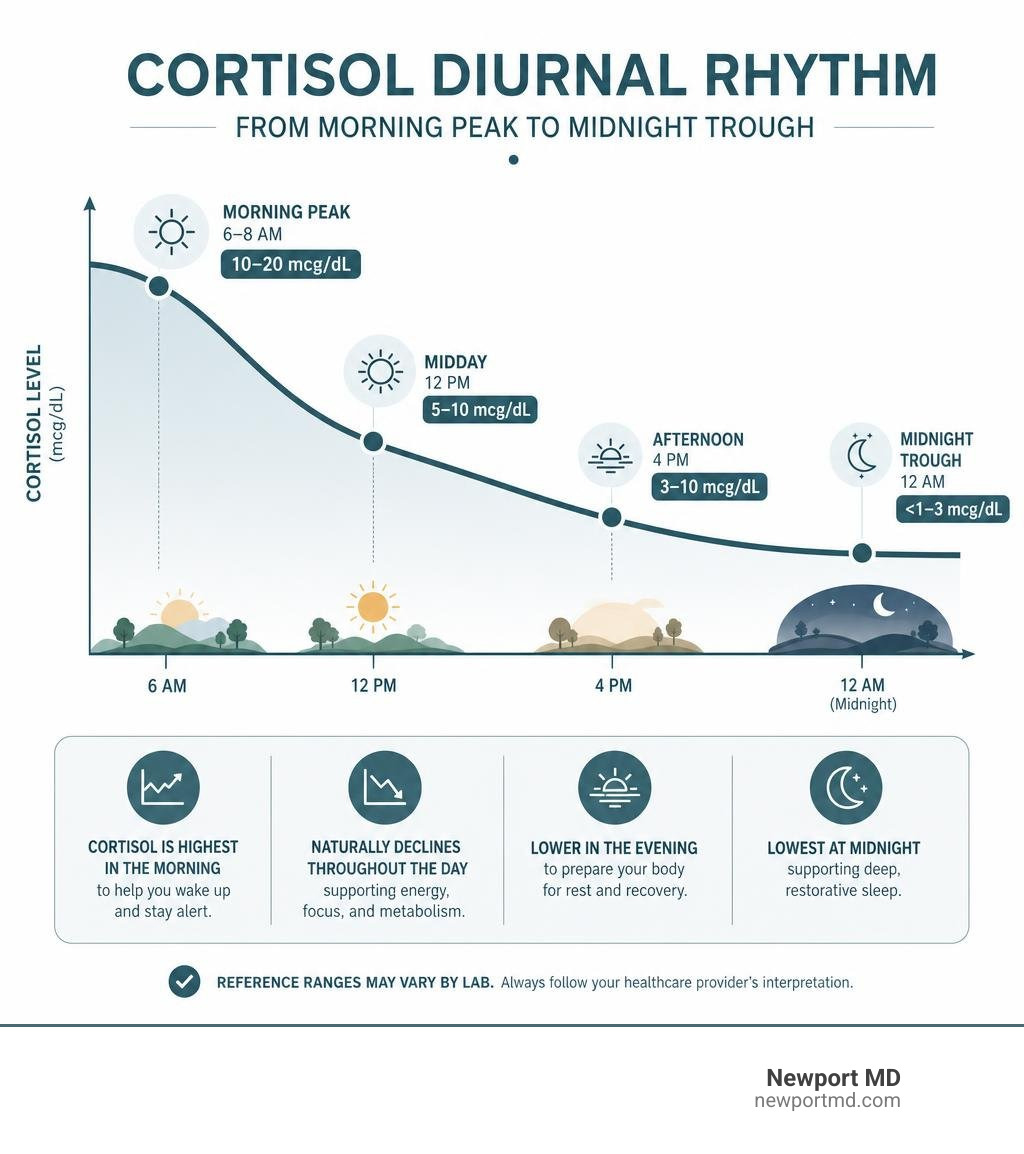
Cortisol usually follows a 24-hour rhythm. It tends to rise in the early morning, peak after waking, gradually decline through the day, and reach lower levels at night.
If a morning blood draw falls within the lab’s reference range and later testing shows an expected decline, that may suggest a normal daily pattern. However, interpretation depends on why the test was ordered, the exact timing of collection, medications, symptoms, and related lab results.
What High Cortisol Levels May Mean
An elevated result on a cortisol level blood test means the measured value was above the lab’s expected range for that sample. Possible reasons may include:
- Medication effects: Glucocorticoid use or other medications can influence cortisol measurements.
- Cushing’s syndrome or Cushing’s disease: These are clinical diagnoses that require additional evaluation; a single blood cortisol result is not enough to confirm them.
- Adrenal or pituitary causes: Some tumors or gland disorders can affect cortisol regulation.
- Physical illness or major stress: Severe illness, surgery, or significant stress can raise cortisol.
- Other health factors: Depression, alcohol use disorder, obesity, and other conditions can affect cortisol patterns.
What Low Cortisol Levels May Mean
A low cortisol result, especially from a properly timed morning test, may prompt evaluation for adrenal insufficiency or pituitary-related causes. Possible reasons may include:
- Primary adrenal insufficiency: The adrenal glands may not produce enough cortisol.
- Secondary adrenal insufficiency: The pituitary may not produce enough ACTH to adequately stimulate the adrenal glands.
- Steroid use or withdrawal: Long-term steroid medications can suppress the body’s own cortisol production, and stopping them too quickly can be dangerous.
Your provider may order additional testing, such as ACTH measurement, ACTH stimulation testing, late-night salivary cortisol, or 24-hour urinary free cortisol, depending on the clinical question.
Frequently Asked Questions About Cortisol Testing
How long do cortisol blood test results take?
Standard laboratory processing for a cortisol level blood test often takes between 1 and 5 business days. The exact turnaround time depends on the lab, testing method, and whether additional specialized testing is ordered.
Can stress or medications alter my test results?
Yes. Cortisol can be affected by stress, sleep, illness, exercise, pregnancy, and medications. Oral contraceptives and estrogen therapy can change total blood cortisol levels because they affect cortisol-binding globulin, the protein that carries cortisol in the blood. Synthetic steroid medications, including some creams, inhalers, pills, and injections, can also affect results. Tell your provider about all medications and supplements before testing.
Is a blood test better than a saliva or urine test?
No single cortisol test is best for every situation. The right test depends on the clinical question.
- Blood tests: Commonly used for morning baseline checks and dynamic testing.
- Saliva tests: Often used for late-night cortisol assessment because samples can be collected at home.
- Urine tests: A 24-hour urine collection can help evaluate total free cortisol output over a full day.
Your clinician may choose one or more testing methods depending on symptoms, timing, medication use, and the condition being evaluated.
Conclusion
A cortisol level blood test can be a useful way to measure cortisol at a specific point in time and help a licensed medical provider evaluate adrenal or pituitary function. Because cortisol changes throughout the day and can be influenced by medications, stress, sleep, and illness, results should always be interpreted in clinical context.
At Newport MD in Newport Beach, CA, blood testing is used as part of a personalized, medically guided approach to wellness and hormone evaluation. Our team can help you understand what your results may suggest and whether additional testing or follow-up is appropriate.
If you are considering hormone or wellness testing, you can take the next step here:
- Book a Consultation with our medical team.
- Learn more about Newport MD blood testing.
- View our full range of services.