

Is Testosterone Therapy Safe or Are You Playing with Fire
Is TRT Dangerous? Here’s What the Evidence Actually Shows
Is TRT dangerous for men dealing with low energy, declining libido, and hormonal imbalance? The short answer: it depends on who is taking it, why, and how it is monitored.
Here is a quick summary before we dive deeper:
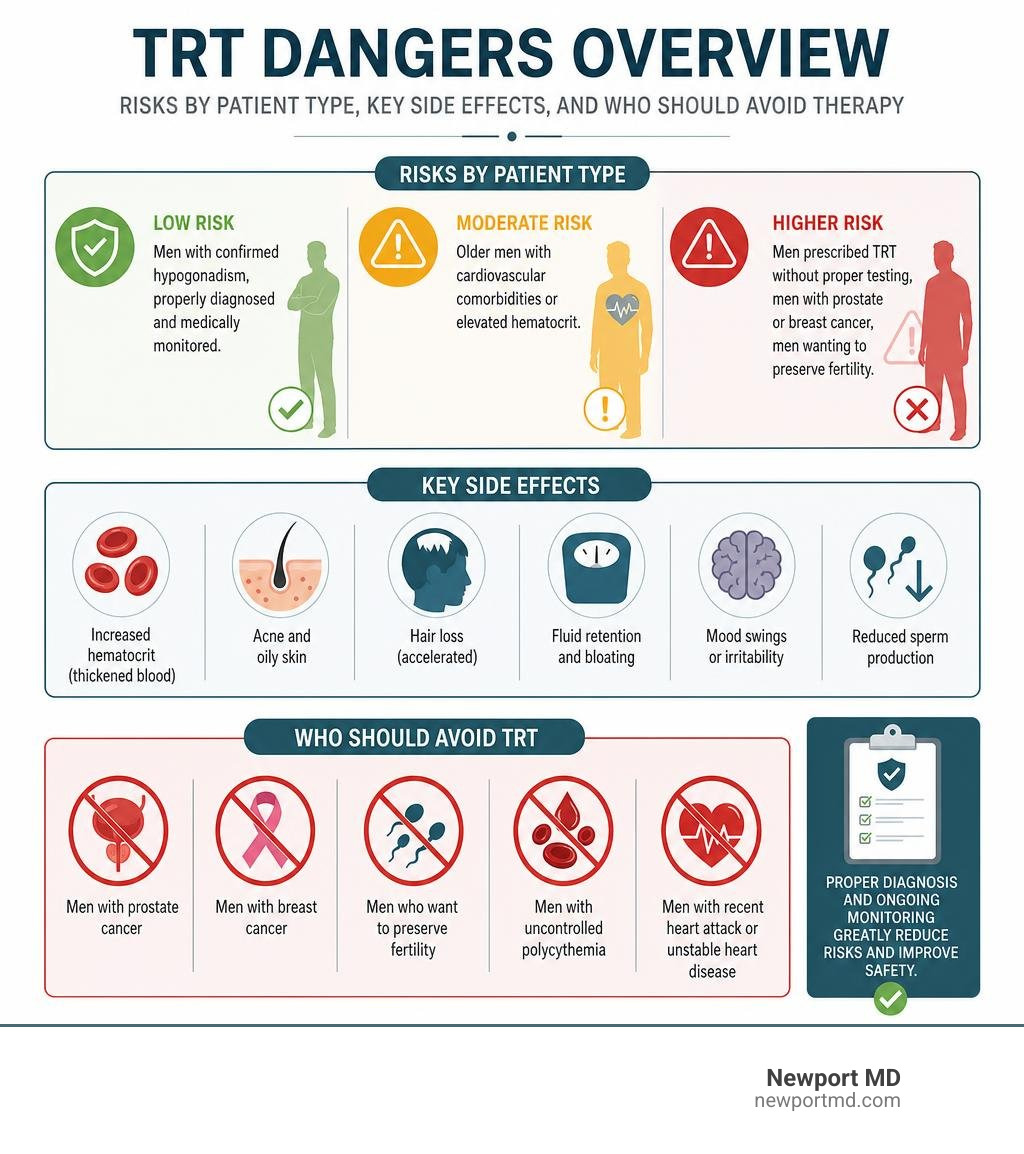
| Risk Level | Who It Applies To |
|---|---|
| Low risk | Men with confirmed hypogonadism, properly diagnosed and medically monitored |
| Moderate risk | Older men with cardiovascular comorbidities or elevated hematocrit |
| Higher risk | Men prescribed TRT without proper testing, men with prostate or breast cancer, men wanting to preserve fertility |
TRT is one of the most talked-about treatments in men’s health right now — and also one of the most misunderstood. Millions of American men currently use prescription testosterone, and between 2001 and 2011 alone, prescriptions among men over 40 more than tripled. If you are considering treatment locally, see our guide to TRT in Newport Beach.
That explosive growth has a dark side. Many men are being prescribed TRT at private clinics without proper testing or follow-up. Others are chasing energy and vitality that TRT may not even deliver without a true clinical deficiency.
At the same time, recent landmark research — including the large-scale TRAVERSE trial — has cleared up some of the biggest fears around heart attack and stroke risk that kept many doctors from prescribing TRT for years.
So the real question is not whether testosterone therapy is good or bad. It is whether you are the right candidate, getting the right dose, and being properly monitored.
This guide breaks all of that down clearly, so you can make a genuinely informed decision.
What is Testosterone Replacement Therapy (TRT) and Who Is It For?
At its core, Testosterone Replacement Therapy (TRT) is a medical treatment designed to restore physiological testosterone levels in men suffering from a clinical androgen deficiency. It is not an over-the-counter supplement, nor is it meant to be a shortcut to athletic enhancement or a magical “fountain of youth” for normal, healthy aging.
The FDA approves TRT specifically for males who have low testosterone levels due to an underlying, diagnosed medical condition—a state known as classical male hypogonadism. This includes primary hypogonadism (testicular failure due to injury, genetic conditions like Klinefelter syndrome, or chemotherapy) and secondary hypogonadism (dysfunction in the hypothalamus or pituitary gland).
To receive a proper clinical diagnosis, a patient must present both clear symptoms of deficiency—such as profound fatigue, muscle loss, depression, and severe erectile dysfunction—and laboratory confirmation. According to the Cleveland Clinic guide on TRT, this laboratory confirmation requires at least two separate morning blood draws showing total testosterone levels below the standard reference range (generally under 300 ng/dL).
The Difference Between Hypogonadism and Natural Aging
It is completely normal for a man’s testosterone levels to decrease as he blows out more candles on his birthday cake. However, there is a massive physiological difference between the gradual, natural decline of aging and the clinical state of hypogonadism.
To put this decline into perspective, let’s look at the data:
- The Massachusetts Male Aging Study reported an annual decline in total and free testosterone of 0.8% to 1.6% and 1.7% to 2.8% per year, respectively, in men over 40 years of age.
- The European Male Aging Study reported a slightly more modest, age-adjusted annual decline in total testosterone of 0.4% per year.
While the Hypogonadism In Men study reported a broad prevalence of hypogonadism at 38.7% in men over 45, the Boston Area Community Health Survey estimated the crude prevalence of symptomatic androgen deficiency—where low levels actually cause clinical distress—at a much lower 5.6%. Surprisingly, only about 12% of these truly symptomatic men are currently treated.
Here is how clinical hypogonadism stacks up against normal, healthy aging:
| Feature | Normal Age-Related Decline | Clinical Hypogonadism |
|---|---|---|
| Rate of Decline | Very gradual (approx. 0.4% to 1.6% per year after age 30 or 40) | Sudden or severe drop well below healthy physiological baselines |
| Testing Levels | Typically remains within the normal lower-range limits | Repeatedly measures below 300 ng/dL |
| Primary Symptoms | Mild changes in sleep or energy; slight shifts in body composition | Severe erectile dysfunction, loss of morning erections, muscle wasting, clinical depression |
| Medical Treatment | Best managed with lifestyle, exercise, sleep, and weight loss | Requires medically supervised hormone replacement |
The Proven Benefits of TRT for Confirmed Low Testosterone
When administered to a man who genuinely has clinical hypogonadism, TRT can be life-changing. It is not about pushing your hormones to superhuman levels, but rather restoring them to a healthy baseline.
When we optimize a patient’s testosterone levels at our clinic, they typically experience:
- Improved Libido and Sexual Function: A significant increase in sexual desire, performance, and satisfaction.
- Optimized Body Composition: Increased lean muscle mass and a reduction in stubborn visceral fat.
- Enhanced Bone Density: Protection against osteoporosis and age-related bone fractures.
- Better Mood and Cognitive Function: Relief from brain fog, irritability, and mild depressive symptoms.
- Restored Energy Levels: A dramatic reduction in the crushing, daily fatigue that lifestyle changes alone cannot fix.
So, Is TRT Dangerous? Weighing the Real Risks and Side Effects

Now we arrive at the core question: is trt dangerous?
Like any active medical therapy, TRT carries potential side effects and risks. It alters your body’s endocrine system, which means it must be treated with respect. Some immediate and minor side effects can include mild acne, temporary fluid retention (which can cause ankle swelling), and gynecomastia (breast tissue swelling) due to the aromatization of excess testosterone into estrogen.
According to a comprehensive Harvard Health analysis on testosterone safety, these minor side effects are highly manageable with proper dosing adjustments. However, there are more significant clinical risks that require careful scientific examination.
Is TRT Dangerous for Your Heart? What the TRAVERSE Trial Revealed
For years, the medical community was deeply divided over the cardiovascular safety of testosterone therapy. Early, flawed studies and a small clinical trial known as the TOM trial—where 23 of the TRT subjects experienced an adverse cardiovascular event compared with only five in the placebo arm—prompted the FDA to mandate prominent cardiovascular warning labels on testosterone products.
However, the landscape completely changed with the publication of the landmark TRAVERSE trial, which followed over 5,200 men aged 45 to 80 with pre-existing cardiovascular disease or high risk factors.
As outlined in the TRAVERSE trial position statement by the European Expert Panel for Testosterone Research, the trial found no statistically significant increase in major adverse cardiovascular events (MACE), such as heart attacks or strokes, in the testosterone-treated group compared to the placebo group. The FDA has since eased its stance, and urologists now agree that therapeutic TRT is highly safe for the heart when properly monitored. It is worth noting, however, that the TRAVERSE trial did observe a slight, minor increase in the incidence of atrial fibrillation and non-fatal arrhythmias, meaning men with pre-existing heart conditions still require close medical oversight.
Prostate Health and the Saturation Model
Another historical fear was that TRT would act as “fuel on a fire” for prostate cancer. This fear was largely based on early-20th-century research that studied very few patients.
Modern urology has debunked this myth using the Saturation Model. This model explains that prostate cells have a limited number of androgen receptors. Once those receptors are fully saturated with testosterone (which occurs at relatively low levels), adding more testosterone does not stimulate further prostate growth or increase the risk of developing prostate cancer.
In the large-scale IPASS study, PSA (Prostate-Specific Antigen) values only increased modestly from a baseline of 1.1 ±0.9 ng/ml to 1.3 ±1.2 ng/ml, with only one case of prostate cancer observed in over 2,000 men. A detailed NIH review on TRT risks confirms that while TRT can cause a minor, normal rise in PSA, it does not increase the risk of localized or aggressive prostate cancer in men without pre-existing disease.
Erythrocytosis and Elevated Red Blood Cell Count
One of the most common, genuine physical risks of TRT is erythrocytosis—an abnormal increase in red blood cell production. Testosterone naturally stimulates the kidneys to produce erythropoietin, which signals the bone marrow to make more red blood cells.
If your hematocrit (the percentage of your blood made up of red blood cells) rises above 54%, your blood becomes thicker, which can theoretically increase the risk of blood clots, deep vein thrombosis (DVT), and pulmonary embolisms.
Interestingly, the Copenhagen City Heart Study found no associations between extreme levels of endogenous testosterone and an elevated risk of deep venous thrombosis or pulmonary embolism. Nonetheless, keeping your hematocrit below 54% through regular blood work, dosage titration, or therapeutic phlebotomy (blood donation) remains a fundamental safety standard of responsible TRT.
Fertility, Sperm Production, and Testicular Shrinkage
For younger men, this is perhaps the most critical side effect to understand: TRT can severely impair your fertility.
When you introduce exogenous (external) testosterone into your body, your brain senses that you have plenty of the hormone. As a result, the pituitary gland stops producing Luteinizing Hormone (LH) and Follicle-Stimulating Hormone (FSH). Without these signals:
- Your testicles stop producing their own natural testosterone.
- Sperm production craters, which can lead to temporary or, in rare cases, long-term infertility.
- The lack of internal hormone production causes the testicles to shrink (testicular atrophy).
If preserving fertility is a priority for you, traditional TRT may not be the right choice. Fortunately, we can often utilize alternative therapies, such as Human Chorionic Gonadotropin (hCG) or Selective Estrogen Receptor Modulators (SERMs), to preserve sperm production and maintain testicular volume.
Lower Urinary Tract Symptoms (LUTS) and Sleep Apnea
It was long assumed that TRT would worsen benign prostatic hyperplasia (BPH) and lower urinary tract symptoms (LUTS), such as weak urine flow or frequent nighttime urination. However, the science tells a different story.
A prospective study of 120 men with testosterone deficiency receiving TRT observed that 38 men (31.7%) actually had an improvement in their American Urological Association Symptom Index (AUASI) of three or more points, while 27 men (22.5%) experienced a worsening of three or more points. For most men, TRT has a neutral or even positive impact on urinary symptoms.
When it comes to Obstructive Sleep Apnea (OSA), the SAGE review on TRT adverse effects notes that testosterone therapy can occasionally worsen sleep apnea, particularly during the first few months of treatment. While this effect is often temporary, any man starting TRT who has untreated or severe sleep apnea should be carefully screened and treated with a CPAP machine.
How to Minimize Risks and Take TRT Safely

Testosterone therapy only becomes dangerous when it is treated like a casual supplement rather than a powerful prescription medication. To safely optimize your hormones, you must follow a strict, clinical protocol that prioritizes safety over quick fixes.
Before you ever receive a single dose of testosterone, a comprehensive baseline blood panel must be performed.
Essential Baseline Blood Tests Before Starting TRT
- Total and Free Testosterone (drawn between 7:00 AM and 10:00 AM on two separate days)
- Prostate-Specific Antigen (PSA) (to screen for pre-existing prostate issues)
- Complete Blood Count (CBC) (specifically checking baseline hematocrit and hemoglobin)
- Estradiol (to monitor estrogen levels)
- Sex Hormone-Binding Globulin (SHBG) (to understand how much active, free testosterone is available in your blood)
- Comprehensive Metabolic Panel (CMP) & Lipid Panel (to track liver, kidney, and cardiovascular health markers)
Why Unregulated Online Clinics Make TRT Dangerous
With the rise of telemedicine, many online “pill mills” and unregulated clinics have popped up, offering quick, same-day prescriptions with minimal testing. This is where is trt dangerous becomes a resounding yes.
These unregulated clinics often overprescribe high doses of testosterone to push patients into supraphysiological ranges (above 1,000 or 1,500 ng/dL). They frequently fail to monitor critical safety markers like hematocrit and PSA, leaving patients vulnerable to blood clots, severe testicular shrinkage, and estrogen spikes.
To ensure your safety, it is vital to work with a hands-on, local medical director who adheres to rigorous clinical standards. A dedicated local clinic can provide the personalized, face-to-face care and precise monitoring that online subscription services simply cannot match.
Age Considerations: Younger Men vs. Older Men
Your age plays a massive role in how we approach hormone optimization:
- Younger Men (Under 45): The primary concern here is the long-term suppression of natural testosterone and fertility. Younger men must be thoroughly evaluated for organic hypogonadism (such as pituitary tumors or testicular injury) before committing to what is often a lifelong therapy. Fertility preservation protocols using hCG are highly recommended.
- Older Men (Over 65): As demonstrated in the landmark U.S. “T Trials,” older men can experience fantastic improvements in mobility, sexual function, and mood. However, older men are also more likely to have underlying cardiovascular disease, subclinical prostate issues, or elevated hematocrit, meaning their monitoring protocols must be exceptionally strict.
The Importance of Regular Blood Work and Monitoring
Once you begin TRT, the work isn’t done. Safe therapy requires ongoing vigilance. We typically check blood levels at the 6-week mark, the 3-month mark, and then every 6 to 12 months once a stable, healthy dose is established.
During these follow-ups, we perform precise dose titrations to ensure your testosterone remains in a healthy, youthful, yet entirely physiological range (typically between 500 and 800 ng/dL). We also closely track your hematocrit and PSA levels to catch and correct any upward trends long before they become clinical issues.
Frequently Asked Questions About TRT Safety
Can you stop TRT once you start?
Yes, you can physically stop TRT, but it is not as simple as just throwing away your medication. Because exogenous testosterone suppresses your body’s natural production by shutting down the Hypothalamic-Pituitary-Gonadal Axis (HPTA), stopping suddenly will cause your hormone levels to crash to near-zero. This can trigger severe withdrawal symptoms, including extreme fatigue, muscle loss, depression, and sexual dysfunction.
If a patient needs to stop TRT, we use a structured Post-Cycle Therapy (PCT) protocol—utilizing medications like hCG and Clomid—to gently reboot their body’s natural hormone production.
How long does it take to see results from TRT?
Hormone optimization is a journey, not an overnight miracle. While some mental clarity and energy improvements can occur within the first 3 to 4 weeks, significant physiological changes take time:
- Libido and Sexual Function: Typically improves within 3 to 6 weeks.
- Mood and Depression: Improvements are usually noticed within 4 to 6 weeks.
- Body Composition (Muscle Gain and Fat Loss): Changes generally become noticeable around the 3-month mark and peak between 6 and 12 months.
- Bone Density: Measurable changes require at least 6 to 12 months of consistent therapy.
Are the long-term effects of TRT well understood?
Yes, the long-term safety profile of TRT is well-documented up to several years of continuous use, especially following large-scale, modern clinical trials like the TRAVERSE study. While we do not have 20-year randomized controlled trials, the observational data on tens of thousands of men using TRT under strict medical supervision shows no increased risk of mortality, prostate cancer, or major cardiovascular events when physiological levels are maintained.
Conclusion: Making an Informed Decision for Your Health
So, is trt dangerous? The scientific consensus in July 2026 is clear: when obtained through unregulated online sources, used for athletic doping, or left unmonitored, TRT can absolutely carry dangerous risks. But when prescribed for genuine clinical hypogonadism, carefully customized to your unique biology, and overseen by expert physicians, TRT is a highly safe, life-changing medical therapy.
You do not have to guess or play with fire when it comes to your hormone health. At Newport MD, we specialize in personalized, science-driven wellness programs with rigorous medical oversight right here in Newport Beach, CA.
If you are ready to stop guessing and start optimizing your health safely, explore our Hormone Optimization programs, our TRT clinic, and comprehensive Services. Learn more About Us and our commitment to clinical excellence, or take the first step toward feeling like yourself again by clicking below to book your medical evaluation.