

Why Low Alanine Aminotransferase Levels Might Actually Matter
When a Low Number on Your Blood Test Is Worth a Second Look
Alanine aminotransferase low results are easy to dismiss. Most people assume a low enzyme level means everything is fine — especially when high ALT gets all the attention as a sign of liver trouble.
But that assumption may be worth questioning.
Here is a quick answer if you just want the essentials:
What does a low ALT level mean?
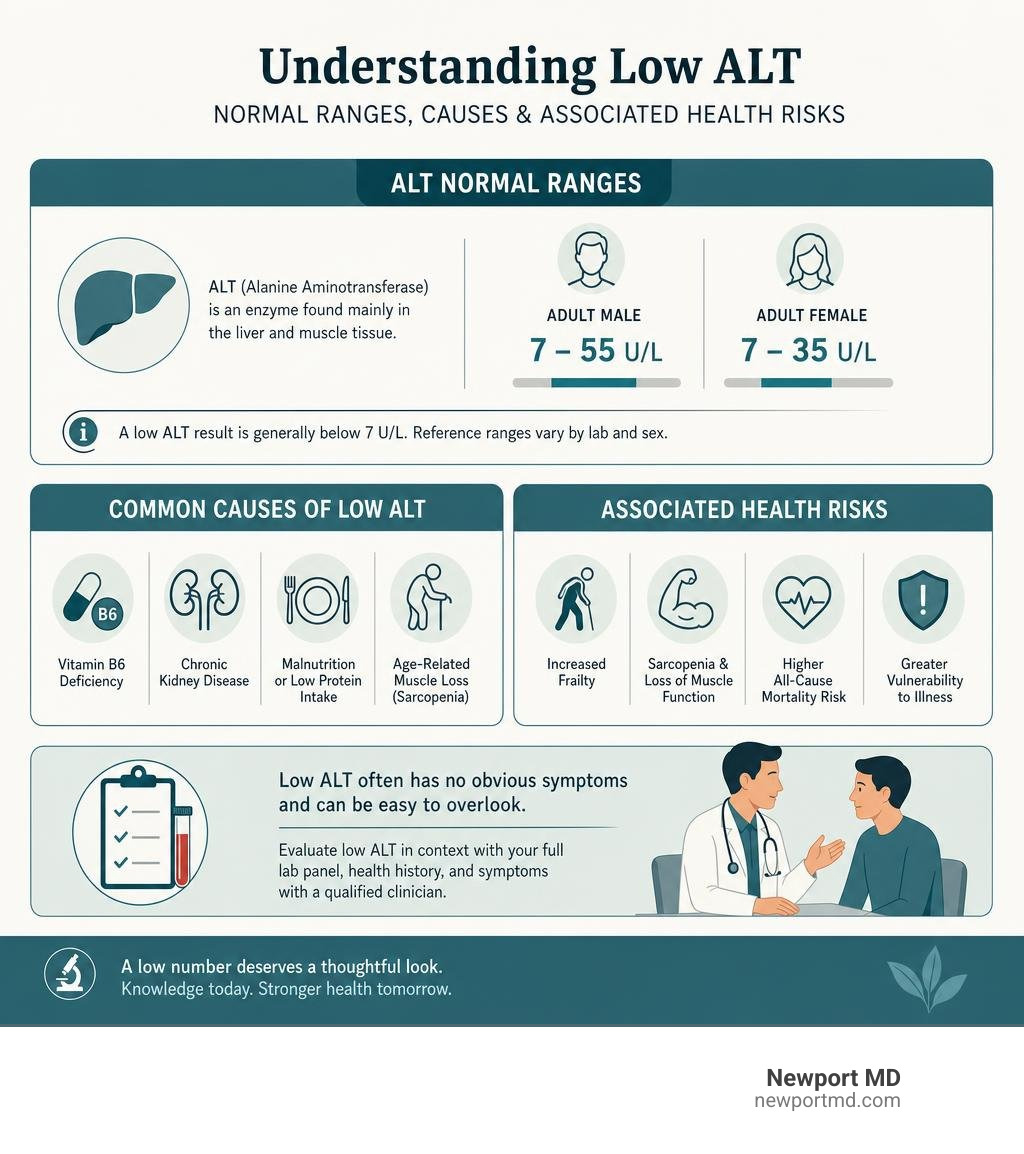
- ALT (alanine aminotransferase) is an enzyme found mainly in the liver and muscle tissue
- A low ALT result is generally below 7 U/L, though reference ranges vary by lab and sex
- Common causes include vitamin B6 deficiency, chronic kidney disease, malnutrition, and age-related muscle loss
- Low ALT often causes no obvious symptoms, making it easy to overlook
- Research suggests low ALT may be associated with increased frailty, sarcopenia, and all-cause mortality risk — particularly in middle-aged and older adults
- A low result should be evaluated in context with your full lab panel, health history, and symptoms by a qualified clinician
Most people — and even many clinicians — are trained to flag high ALT. Low ALT rarely triggers a second look. But a growing body of research suggests it probably should, particularly for adults in their 40s and 50s who are already paying attention to energy, performance, and long-term health.
One large cohort study following over 23,000 adults for a median of 8.5 years found that ALT levels below 17 IU/L were associated with a 1.6-fold increased risk of all-cause mortality — even after adjusting for age, kidney function, diabetes, and heart disease. That is not a small signal.
This guide breaks down what low ALT actually means, what may cause it, and why it deserves more attention than it typically gets.
What is Alanine Aminotransferase (ALT) and Its Role?
To understand why having an alanine aminotransferase low reading matters, we first have to look at what this enzyme actually does.
Alanine aminotransferase, commonly known as ALT (and previously referred to as SGPT), is a specialized protein that serves as a metabolic catalyst. Its primary job is to speed up chemical reactions in the body. Specifically, ALT plays a crucial role in cellular energy production by facilitating the transamination process—the reversible transfer of an amino group from alanine to alpha-ketoglutarate. This reaction generates pyruvate, a vital building block that your cells use to produce energy.
While many people associate ALT exclusively with liver function, it is also present in other tissues, including skeletal muscles, the heart, and kidneys. However, because the liver contains the highest concentration of this enzyme, the Alanine Transaminase (ALT) Blood Test – Cleveland Clinic is most frequently used to evaluate liver health.
When liver cells are irritated, inflamed, or damaged, they leak ALT into the bloodstream, causing serum levels to spike. Because of this, standard medical training focuses heavily on elevated ALT. However, because ALT is deeply involved in muscle metabolism and overall amino acid processing, a lack of circulating ALT can point to systemic issues that have very little to do with the liver itself.
It is also helpful to understand how ALT differs from aspartate aminotransferase (AST), another enzyme frequently measured alongside it in a standard liver panel. While both are metabolic enzymes, AST is found in much larger quantities throughout the heart, skeletal muscles, kidneys, and brain. Because ALT is more concentrated in the liver than AST, it is considered a more specific biomarker for liver-related events. However, when both enzymes are unusually low, it often points to a broader systemic issue, such as metabolic slowdown or muscle loss.
Understanding Alanine Aminotransferase Low Levels and Reference Ranges
When you receive a lab report, your results are compared against a standard reference range. These ranges are not universal; they can vary slightly depending on the laboratory analyzing your sample and the specific testing methods used.
According to the Definition of Healthy Ranges for Alanine Aminotransferase Levels: A 2021 Update, standard healthy ranges are typically defined using the 95th percentile of a low-risk population. However, traditional reference ranges have historically focused on establishing the upper limit of normal (to catch liver disease) while paying very little attention to the lower limit.
For most standard laboratories, the typical reference ranges are:
- Adult Males: 7 to 55 U/L (units per liter)
- Adult Females: 7 to 45 U/L
Because men generally have greater skeletal muscle mass than women, their baseline ALT levels tend to be slightly higher.
A value that falls below 7 U/L is widely considered abnormally low. However, emerging clinical research suggests that the “functional” lower limit might actually be higher. Many longevity researchers and functional medicine clinicians look at values below 15 to 17 U/L as a potential warning sign, particularly in older adults or those managing chronic health conditions.
| Group | Standard Reference Range | Low ALT Threshold (Traditional) | Functional Low ALT Threshold (Clinical Association) |
|---|---|---|---|
| Adult Males | 7 – 55 U/L | < 7 U/L | < 17 U/L |
| Adult Females | 7 – 45 U/L | < 7 U/L | < 15 U/L |
As we age, our ALT levels naturally tend to decline. This age-related drop is not necessarily a sign of a healthier liver; rather, it is often a reflection of the gradual loss of skeletal muscle mass that occurs with aging. Understanding this distinction is key to recognizing why an alanine aminotransferase low result deserves clinical context.
Potential Causes of Low ALT Levels
If a low ALT level does not mean your liver is in perfect shape, what does it mean?
In many cases, a low ALT reading is simply a reflection of a person’s unique physiology, lifestyle, or metabolic rate. For instance, individuals who lead highly sedentary lifestyles or those with a very small frame may naturally have lower circulating levels of the enzyme. However, when ALT drops significantly below the standard range, it is often a clue pointing toward underlying nutritional, metabolic, or medical factors.
According to clinical insights from A Low ALT Blood Test Often Has Nothing to Do With Your Liver, a persistently low ALT level is frequently a surrogate marker for systemic changes rather than liver disease. It is the body’s quiet way of signaling that its metabolic reserves or muscle mass may be depleted.
To understand why this happens, we have to look at the specific nutritional and medical factors that can cause ALT production to stall.
Nutritional Deficiencies and Alanine Aminotransferase Low
One of the most common and easily correctable causes of low ALT is a nutritional deficit, particularly a lack of active Vitamin B6.
The ALT enzyme cannot perform its metabolic duties alone. It requires a specific coenzyme called pyridoxal 5’-phosphate (PLP), which is the active form of Vitamin B6, to function. If you are deficient in Vitamin B6, the ALT enzymes in your body cannot activate properly, leading to an abnormally low reading on your blood test.
According to the Alanine aminotransferase (ALT) blood test – Mayo Clinic, a vitamin B6 deficiency is one of the primary non-hepatic causes of low ALT. This deficiency can stem from:
- Poor Dietary Intake: Not eating enough B6-rich foods, such as poultry, fish, bananas, chickpeas, and leafy greens.
- Malnutrition or Malabsorption: Conditions like celiac disease, Crohn’s disease, or general gut inflammation that prevent your body from properly absorbing nutrients.
- Lifestyle Factors: Chronic alcohol consumption or smoking, both of which can deplete the body’s active B6 reserves.
- Certain Medications: Some prescription drugs, including oral contraceptives (birth control pills) and certain hormone therapies, can interfere with B6 metabolism and lower ALT levels.
Additionally, a diet severely lacking in protein can lead to muscle wasting and amino acid depletion, further contributing to a decline in ALT.
Medical Conditions Linked to Alanine Aminotransferase Low
Beyond nutrition, several medical conditions can influence how much ALT is produced or detected in the bloodstream.
- Chronic Kidney Disease (CKD): Individuals with advanced kidney disease often show very low ALT levels. This is partly because uremic toxins (waste products that build up when the kidneys cannot filter blood properly) can inhibit enzyme activity or interfere with the laboratory assays used to measure ALT.
- Genetic Mutations: In rare cases, individuals may carry genetic variations that affect their ability to produce the ALT enzyme. A fascinating case report, Abnormally Low Alanine Aminotransferase Ameliorated by a Living Donor Liver Transplantation: A Case Report, documented a patient with an extremely low preoperative ALT level of just 1 IU/L due to suspected genetic factors, which normalized only after receiving a liver transplant. While liver transplantation is obviously not a standard treatment for low ALT, this case highlights how genetic quirks can sometimes mask underlying liver status by keeping enzyme levels artificially low.
- Hormonal and Metabolic Shifts: Conditions that slow down overall metabolic rate, such as severe hypothyroidism, may also be associated with lower enzyme activity across the board.
The Health Implications: Why Low ALT is a Biomarker for Frailty and Mortality

While a high ALT level clearly warns of acute liver inflammation, a low ALT level is increasingly recognized as a quiet marker for systemic vulnerability. Specifically, low ALT is emerging as a powerful surrogate biomarker for sarcopenia (the progressive loss of skeletal muscle mass and strength) and physical frailty.
Because skeletal muscle is one of the primary storage sites for ALT outside of the liver, a decline in total muscle mass naturally leads to less ALT circulating in the blood. In other words, a very low ALT level can be a sign that a person is losing their muscle “reserve.” This is particularly critical for older adults, as muscle mass is directly tied to mobility, balance, metabolic health, and the ability to recover from illness or injury.
The clinical data linking low ALT to serious long-term health outcomes is compelling:
- All-Cause Mortality in the General Population: A historical prospective cohort study following 23,506 adults for a median of 8.5 years revealed that low ALT levels (defined as <17 IU/L) were associated with a 1.6-fold increased risk of all-cause mortality (HR=1.6; 95% CI 1.34–1.92; p<0.001). This association remained statistically significant even after the researchers adjusted for age, sex, kidney function, albumin levels, and pre-existing conditions like diabetes and heart disease. For more details, you can read the Research on low ALT and long-term mortality in adults.
- Cardiovascular Mortality in Heart Disease Patients: In a long-term study of 6,575 patients with stable coronary heart disease followed over 22.8 years, low ALT (<17 IU/L) was independently associated with an 11% greater risk of long-term mortality (HR 1.11; 95% CI 1.03–1.19; p=0.01). The cumulative all-cause mortality was significantly higher in the low ALT group (65.6%) compared to those with higher ALT levels (58.4%). Furthermore, the probability of mortality ranged from 69% in the lowest ALT decile to 56% in the highest decile within the normal range—representing a stark 13% absolute difference. You can explore this data further in the Study on low ALT and mortality in coronary heart disease patients.
- Vulnerability in Fatty Liver Disease: Counterintuitively, even in patients with nonalcoholic fatty liver disease (NAFLD), lower ALT levels can signal trouble. Research published in the Research on lower ALT levels and mortality in NAFLD patients indicates that NAFLD patients with ALT levels below 0.5 times the upper limit of normal (ULN) experienced the highest rates of all-cause and cardiovascular mortality. While high ALT in NAFLD indicates active liver inflammation, an abnormally low ALT may reflect advanced systemic frailty or sarcopenia, which carries its own severe cardiovascular risks.
These studies suggest that a very low ALT is not a sign of superior liver health, but rather a potential signal of diminished physiological reserve, making it an excellent tool for identifying early aging or frailty.
Diagnosing and Managing Low ALT Levels
If your recent blood work reveals a low ALT level, the first step is not to panic, but to look at the bigger picture. A single low value in isolation is rarely an emergency. Instead, it is an invitation to explore your overall nutritional status, muscle mass, and metabolic health.
When evaluating your results, a healthcare provider will typically look at your ALT as part of a Comprehensive Metabolic Panel (CMP) or a dedicated liver function panel. According to the ALT Blood Test: MedlinePlus Medical Test, comparing ALT with other markers like AST, albumin, bilirubin, and kidney function indicators (like creatinine and eGFR) helps clinicians determine whether the low reading is due to a localized issue (like B6 deficiency) or a systemic pattern (like muscle loss or kidney dysfunction).
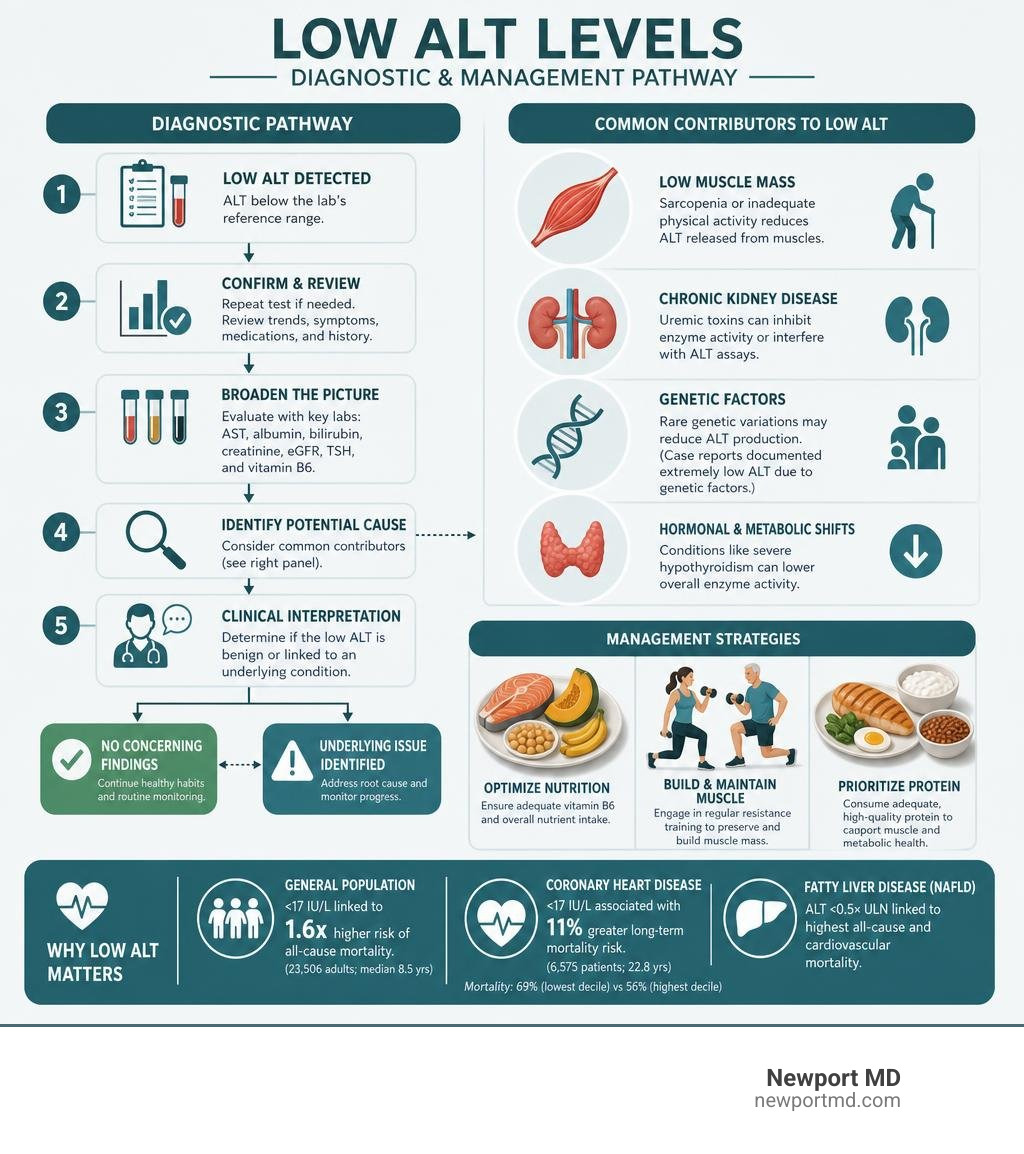
If your clinician determines that your low ALT warrants attention, management strategies are typically highly personalized and focused on addressing the root cause:
- Optimize Vitamin B6 Intake: If a B6 deficiency is suspected, incorporating more B6-rich whole foods into your diet is an excellent starting point. Excellent sources include chickpeas, wild-caught fish, poultry, bananas, and winter squash. In some cases, a high-quality pyridoxal 5′-phosphate (PLP) supplement may be recommended under medical supervision.
- Support Muscle Mass with Resistance Training: Because low ALT is closely tied to sarcopenia, engaging in consistent, progressive resistance exercise is one of the most effective ways to preserve and build skeletal muscle. Strength training not only supports healthy muscle mass but also improves metabolic rate and insulin sensitivity.
- Prioritize Dietary Protein: Ensuring you consume adequate, high-quality protein provides the necessary amino acids to support muscle protein synthesis and overall metabolic function.
- Review Medications and Supplements: Work with your doctor to review your current medications, especially if you take oral contraceptives, hormone therapies, or other prescriptions that might influence B6 levels or enzyme activity.
Frequently Asked Questions about Low ALT
What symptoms are associated with low ALT?
In the vast majority of cases, having a low ALT level does not cause any direct symptoms on its own. Instead, any symptoms you experience will typically stem from the underlying cause. For example, if your low ALT is driven by a severe Vitamin B6 deficiency, you might experience persistent fatigue, muscle weakness, mild cognitive changes (like difficulty concentrating), or occasional numbness and tingling in your hands and feet. If it is related to sarcopenia, you might notice a gradual loss of physical strength or reduced exercise tolerance.
How does low ALT differ from high ALT?
High ALT and low ALT represent two very different physiological states. High ALT is a direct marker of cellular damage or inflammation, usually in the liver. When liver cells are injured by alcohol, toxins, viruses (like hepatitis), or excess fat accumulation, they spill ALT into the blood, causing levels to rise.
Conversely, low ALT is generally not a marker of acute tissue damage. Instead, it is a marker of depleted metabolic resources, low muscle mass, or cofactor deficiencies (like B6). High ALT tells us that a tissue is actively inflamed; low ALT suggests that the body’s overall physiological reserve or muscle mass may be diminished.
When should I see a doctor for low ALT?
You should discuss your low ALT levels with a healthcare provider during your routine wellness exams or if the low reading is accompanied by other unexplained symptoms like chronic fatigue, unintended weight loss, or muscle weakness. Because a low ALT level is most valuable when interpreted alongside other biomarkers, a comprehensive metabolic evaluation is the best way to determine if any lifestyle or nutritional adjustments are needed to support your long-term vitality.
Conclusion
An alanine aminotransferase low result is a reminder that optimal health is about balance, not just avoiding high numbers. While standard medicine is designed to watch for the warning signs of disease, health optimization is about reading the subtle, quiet signals your body sends when its reserves are beginning to run low.
At Newport MD, located in beautiful Newport Beach, CA, we specialize in helping you decode these exact signals. We believe that true wellness requires looking beyond standard “normal” ranges to understand what your unique biology needs to perform at its best.
Whether you are looking to address age-related muscle loss, optimize your nutritional foundation, or explore how targeted hormone and peptide therapies can support your vitality, our team is here to guide you with personalized, science-driven wellness programs under expert medical oversight.
If you are ready to take a deeper, more proactive look at your health, we invite you to explore our Comprehensive Blood Testing Services and partner with us on your journey to optimal health.